AOL's Instant Messenger was the unsung hero of the early-aughts


It's kind of incredible that these days, barely a day goes by that I don't think about AOL Instant Messenger (or AIM, as I'll call it throughout) at some point.
That statement doesn't make sense on the face of it even to me, since I only used AOL in the 1990s for a short time before I found cheaper ways to get online at home. And I scoffed at all the chat functionality within AOL and didn't understand how a friend was ride or die for their chat room buddies from AOL and kept an AOL account going for years after they needed it, just to talk to their AOL friends.

My first usage of instant messaging was downright jurassic. Back in grad school in the mid-1990s, every grad student had an account on an old 1970s VAX/VMS system, and you could use a command-line function to see who else was at the terminal just like you were, then you could start a >TALK session that was truly instant (you could even watch people type out their messages to you and see them fix their typos in real-time).
Since the pool of colleagues I could connect with was so small and time-sensitive on TALK, most grad students tended to use ICQ, with its cute sounds that evoke instant nostalgia whenever I hear them today (uh-oh!). That meant any time you were sitting at a computer, ICQ would let you know who else was and let them know you were around too, way easier than TALK.
AIM came out around the same time but I avoided it at first because it was AOL and AOL was already a dinosaur by the late 1990s. But ICQ was more niche, as you had to memorize your userID (and judge others based on theirs) just to login while AIM just kind of worked everywhere and was easier overall to use. Once enough of my friends moved to AIM, I held my nose and moved along with them and never looked back.
What it was like in the heyday
I want to say between the years of 2000 and about 2010, I always had an AIM client running on any computer I was using while I was sitting at it. It was kind of like using Slack at a workplace today, but you'd glance over at your list to see who was online currently and catch up with people constantly throughout the day, or even just read their away messages.
Back in the early days of blogging, people who read blogs used to joke that everyone with a blog seemed to know everyone else with a blog and they linked to one another and talked on their blogs like some sort of "secret cabal" or "cult". And yeah, we had annual gatherings like SXSW where bloggers met up in person but the simple fact was we also had AIM running on our desktops.
Maybe it was 9am and I was procrastinating before starting work, and I'd see my friend Dan in Wisconsin that also ran a blog was online and I could tell him how much I enjoyed a recent post of his, or ask him what he was doing for the upcoming holiday weekend and hear weird stuff like how everyone in the midwest somehow owns a boat.
Every blogger knew every other blogger because we talked on AIM constantly throughout the day. I probably read 200-300 daily-updated blogs back in this era and I probably had 50-60 blog authors in my AIM list each day that I could connect with.
Apple even integrated it into the OS
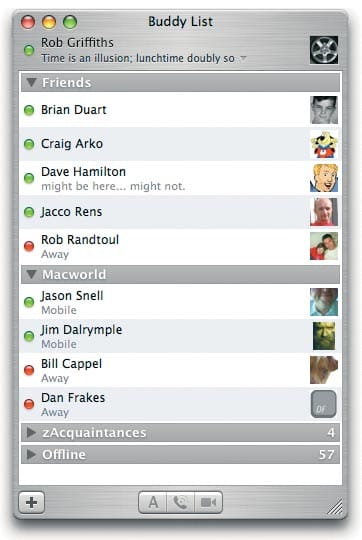
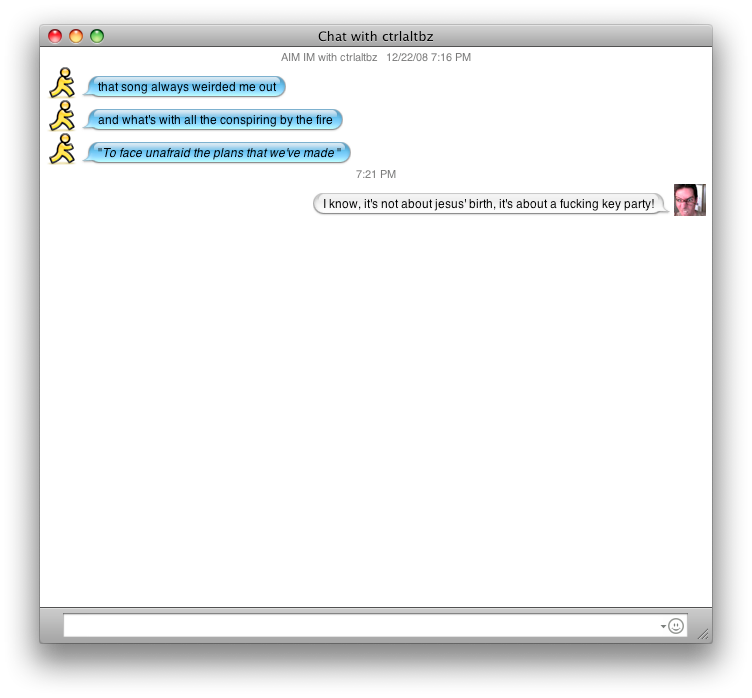
In early versions of Mac OS X, Apple added iChat, which was basically AIM plus local network Bonjour/Jabber messaging, and eventually it supported other IM clients like Yahoo and MSN.
Once it was integrated into the operating system, it became a vital work tool. Everyone I worked with remotely at Creative Commons was using Macs and on AIM. All my non-work internet friends were also on AIM. When you were at a conference, you could even pop open a iChat window to find anyone else using the same WiFi network also using iChat, and drag their name into your buddies list (which is how I accidentally knew when Tim O'Reilly was online for the next 4-5 years).
Online status became a vital feature

I posted this image to Flickr in 2004, showing all my away messages/status settings over the previous year, which included presidential election night 2004 and the World Series, and where I traveled to each month while working at Creative Commons, along with the offline messages I used for my coworkers whenever I popped out for lunch or had to go to the doctor.
The ones about travel were interesting. I'd put "NYC" as my status as I flew into New York for a conference or a visit for a few days and inevitably 2-3 people would message me at some point in the trip and say "hey, you're here? let's get lunch!" and we'd get food together.
Biz Stone mentioned in his book about the formation of Twitter that my away statuses image posted to Flickr drove early ideas around Twitter, because people wanted to share their online status with each other in a subtle way. The first time I used early "Twttr" it was basically a way over SMS to tell your friends what your current status was ("at the store" was a complete message on early twitter).
One-on-one social connections were key
It's funny, but as I look up old images and screenshots of iChat and AIM in Google, I see a lot of promotional stuff from Apple and AOL touting group chat features or the iSight camera's video conferencing that came out a decade before Zoom meetings were even an idea.
But I rarely talked to more than one person at a time over iChat or AIM. It was almost always one-on-one, and I still miss being able to keep track of dozens of friends easily and instantly over so many years. Granted, this was during a transitional period where you still had your offline life and your online life and AIM worked to tell you when your online friends were also briefly online, which added to this feeling of temporary kinship.
Today, I have several hundred contacts in my phone and I could conceivably text them instantly to try and recreate the feeling I had using AIM, but it's not at all the same and so many of those loose connections have withered over the years. These days, if I decide to text someone for the first time in two years, I usually have to explain why because it seems so out of the blue.
Why didn't early internet apps make the transition to mobile?
Something I think about constantly is why didn't AIM become another killer communication app like WhatsApp or Telegram, just a thing everyone uses to communicate no matter where they are or what devices they are using. The same question could be asked about Flickr. Why didn't Flickr go from an online photo sharing app to becoming the way all mobile phone users to share photos with each other and with the public?
In AIM's case, I think AOL was in the dark ages about mobile app development and as we moved off desktop computers and when being "online" meant when you were at your desk with a keyboard, compared to just always being reachable by your mobile phone as the idea of "online" faded to just being on 24/7. AIM was slow to adapt and I remember downloading an official AIM client on my iPhone around 2010 but barely anyone used it and I rarely did as well. The Apple iChat app moved away from being a pipeline for other protocols like AIM messages as it embraced texting and iPhones instead.
There wasn't a way to transition how someone might use iChat at their desk with work colleagues, when compared to the iMessage app on your phone that was focused almost completely on just texting other iPhones (and Apple wanted to sell more iPhones so they pushed that way).
I think Flickr didn't become a great mobile app because Yahoo flubbed the same brief opportunity in ways that AOL did, by waiting too long and not having enough features or surfacing why someone would use an app different from the built-in tools already on their phones.
A transitional period we can't recreate
I miss keeping up with 50 other bloggers and talking to people all over the planet each day. We're all so dispersed now but online all the time that the thing I miss most doesn't really exist.
Back in 2005, I would be at my desk using a computer for maybe 8hrs a day and that would overlap in the mornings with my British blogger friends who were finishing their workday at the BBC. For most of the day I chatted with coworkers and occasionally other bloggers but in the late afternoon I might hear from friends in Sydney, Australia or my Japanese pals as they got to their desks before my day was ending.
These days, I am happy to say I usually use my desktop Mac for only an hour or two a day tops, and frequently go days without touching it. Apple tells me I use my phone about 4-6 hours per day, so it's not like I'm "offline" all that much compared to 2005.
I still miss AIM even though it shuttered forever in 2017. It connected so many people to me, kept us all in touch and updated on what we were all up to. The ephemeral nature of connecting with friends when they were at their desks just like you were (and everyone had a full keyboard to write full sentences quickly) captured a magic moment that nothing today can compare to, and I still miss it to this day.